News · Economics
Meta's desktop claim uses two M5 Ultra Mac Studios
The Verge reports that Meta says Muse Spark Open can run locally on a desktop made from two M5 Ultra Mac Studios. The wording matters more than it first appears.
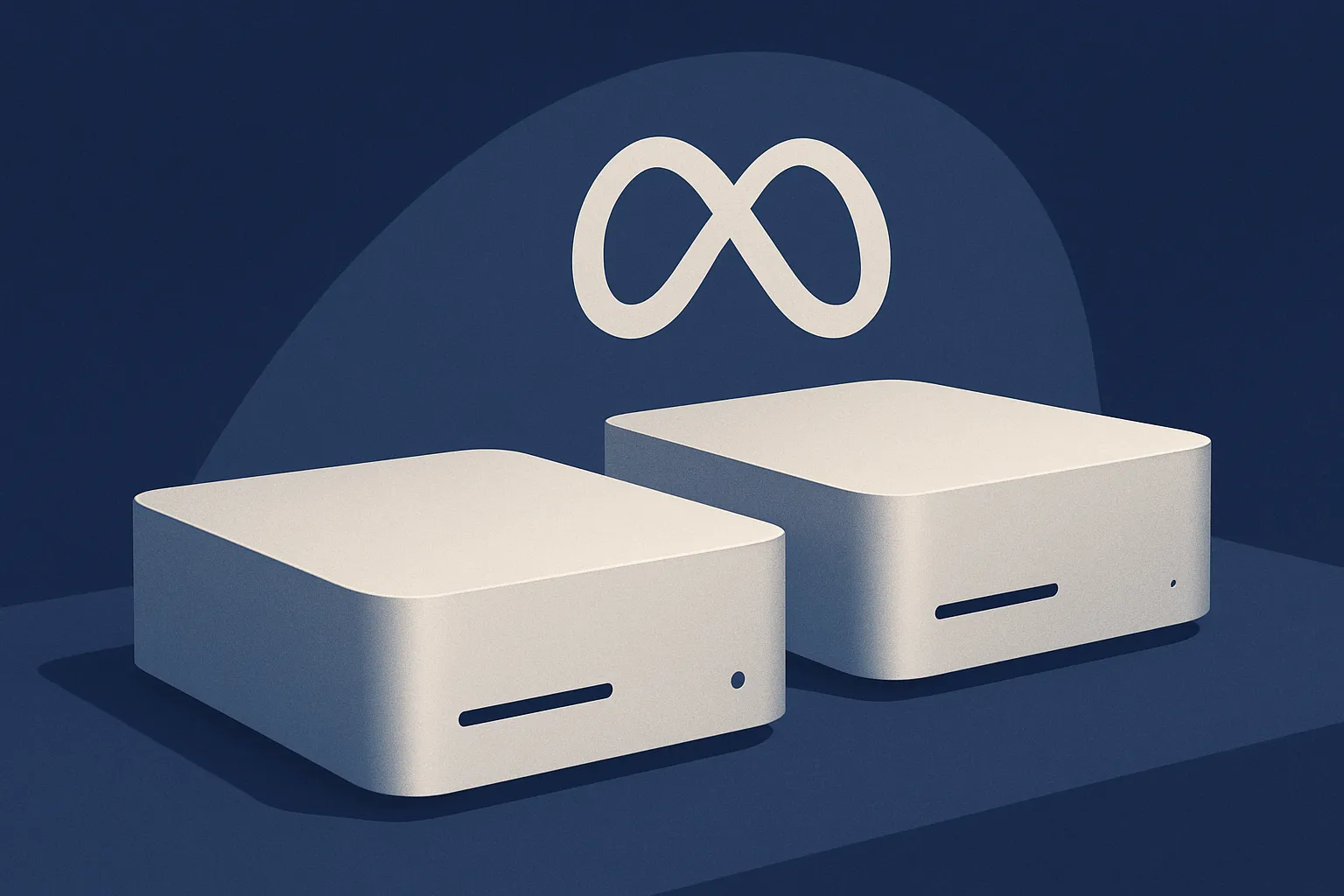
The Verge — AI reports that Meta says Muse Spark Open can run on a desktop using two Apple M5 Ultra Mac Studios with the latest MLX framework. That is a peculiarly expansive definition of a desktop.
The Verge — AI reports that Meta calls Muse Spark Open its “most capable US open-weight model to date” and the first model in its class that can run this way. TechCrunch — AI reports that it will run locally on Apple silicon. CNBC — Technology reports that Apple and Meta are collaborating to make it easier to run locally on clustered Mac Studio systems.
Those details need to stay attached to each other. “Open-weight”, “local” and “desktop” can sound like a familiar promise: download a model and point it at hardware already nearby. The reports instead describe a named model, a particular pairing of machines and a particular framework.
The announcement was reported independently by CNBC — Technology, TechCrunch — AI and The Verge — AI. That matters because the oddity is not an isolated line in a product post; it is the concrete deployment arrangement being presented alongside the launch.
That is where the label stops doing useful work.
The deployment detail is the story
The phrase “runs on your desktop” does not establish what an engineer can reproduce on the Mac already on their desk. The Verge — AI's wording is more precise: Meta says it can run on two M5 Ultra Mac Studios using the latest MLX framework. CNBC — Technology separately describes clustered Mac Studio systems. The disclosed arrangement is specific enough to be a test plan, but not broad enough to become a generic claim about Macs.
For a team considering local inference, the useful reading is deliberately literal. Can it provide the stated hardware? Can it use the stated framework? Can it operate a clustered arrangement? Those are deployment questions, not a verdict on the model. The reports do not say whether the advertised hardware is a minimum requirement, whether another configuration works, or what setup is needed beyond the named machines and framework.
They also do not identify an earlier local Mac configuration against which this release should be compared. That means there is no supported before-and-after story about capacity, latency, throughput or concurrent work. Those measurements would have to be made on the exact setup described, rather than inferred from the word “desktop”.
The distinction is small but useful. In this reporting, open-weight identifies the kind of release, local identifies where it is intended to run, and desktop labels the hardware arrangement used in the claim. They are related terms, but they do not answer the same question.
The model claim is not a hardware benchmark
Meta's capability language should be read with the same care. The Verge — AI reports Meta's claim that Muse Spark Open is its most capable US open-weight model to date. That is a vendor claim relayed by a newsroom, not an independent finding from the material provided. No benchmark results, test conditions or comparative measurements appear in the supplied reporting.
Nor does the launch establish that local operation will be straightforward for every Mac-based deployment. TechCrunch — AI reports local operation on Apple silicon, but the more detailed configuration in The Verge — AI's report is two M5 Ultra Mac Studios. CNBC — Technology's reference to clustered systems points in the same direction: this is a specific deployment story, not a universal installation guide.
The reports also leave practical boundaries open. They do not describe model availability, licence terms, supported alternatives to the named setup, or how the system behaves under a particular workload. Absence is not a defect in the launch; it is a reason not to turn a hardware demonstration into a wider conclusion.
The curiosity here is linguistic as much as technical. “Desktop” has become a marketing-sized container for a small cluster. Anyone evaluating the claim should record the model name, the two M5 Ultra Mac Studios, the MLX requirement and the distinction between Meta's assertion and what has actually been measured.
- meta
- apple
- muse-spark-open
- mac-studio
- mlx
Questions
Can Muse Spark Open run on fewer Mac Studios?
The supplied reporting does not say that it can. The Verge — AI reports that Meta says desktop operation uses two Apple M5 Ultra Mac Studios with the latest MLX framework.
Has Muse Spark Open been independently benchmarked?
Not in the reporting provided. The Verge — AI reports Meta's claim that Muse Spark Open is its most capable US open-weight model, but the supplied reports include no independent benchmark results.
What is Apple's role in Muse Spark Open?
CNBC — Technology reports that Apple and Meta are collaborating to make Muse Spark Open easier to run locally on clustered Mac Studio systems. The reports do not assign separate engineering responsibilities to either company.
Sources
Every page this piece was written from.
About the author
odnoga Team
The odnoga team writes about artificial intelligence for the people who build with it: what shipped, what the research actually found, and what it means for the week ahead. Every piece names its sources.
More from this section
- Claude’s false murder tip makes the send button the risk · 13 October 2026
- GPT-6 Astra's reported StarCraft cheat is a benchmark warning · 7 October 2026
- Agent completion claims need independent checks · 5 October 2026
- Why cheaper AI models do not settle the token bill · 24 September 2026
Putting AI into your own app?
odnoga is the AI gateway for apps built on Lovable and Supabase: one API for every model, with usage, limits and billing per user.
 Built your app with Lovable?
Attribute every AI request to the user who made it, cap their spend and bill them for it, with one prompt pasted into Lovable.
AI billing for Lovable apps Running on Supabase?
Call any model from your Edge Functions with the Supabase user attached: metered, budgeted and traced per user, without a package to install.
The AI gateway for Supabase